Research on geology, geophysics, and petrology of impact structures (meteorite impact craters)
Search Visitors
Home -> Spain -> Azuara impact structure -> Shock effects
back
Shock effects


Enlarge the images to full screen size by clicking the mouse on them! Downloading may be time consuming.

Shock effects in rocks from the Azuara impact structure

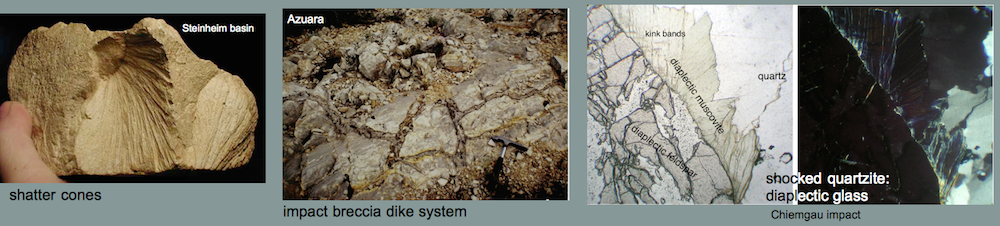
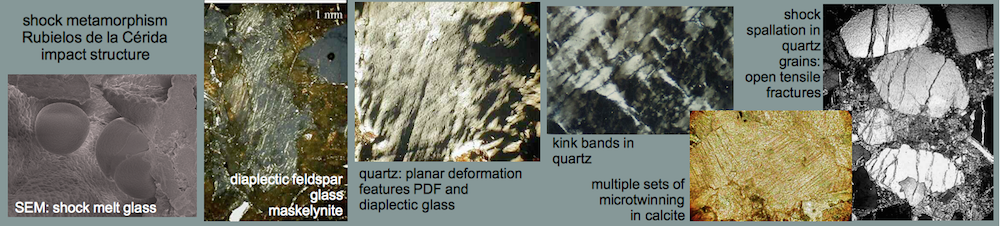
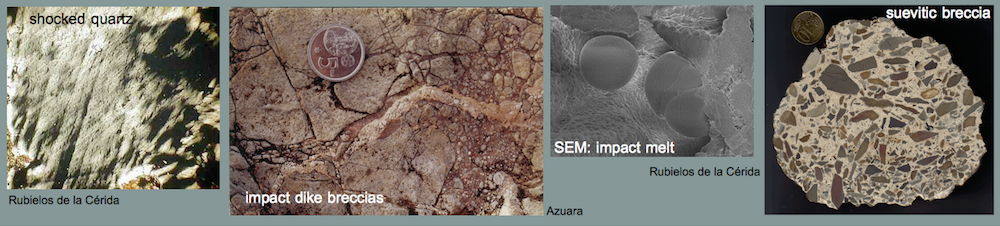
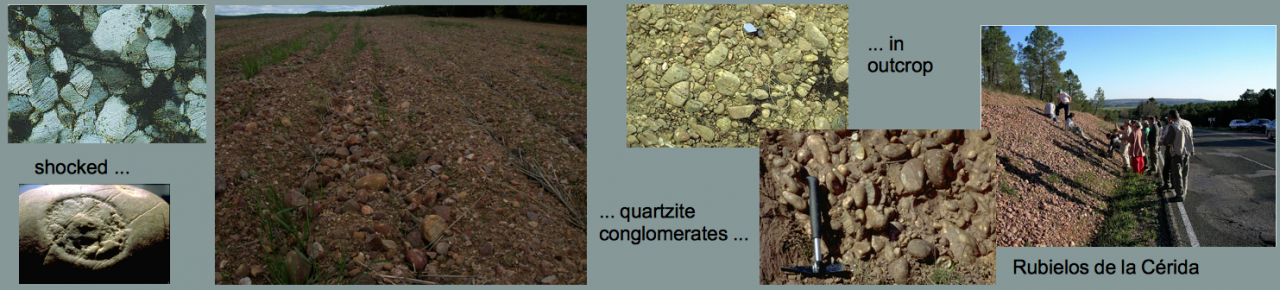
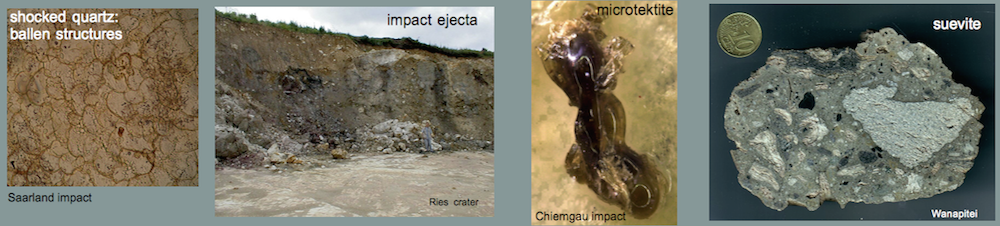
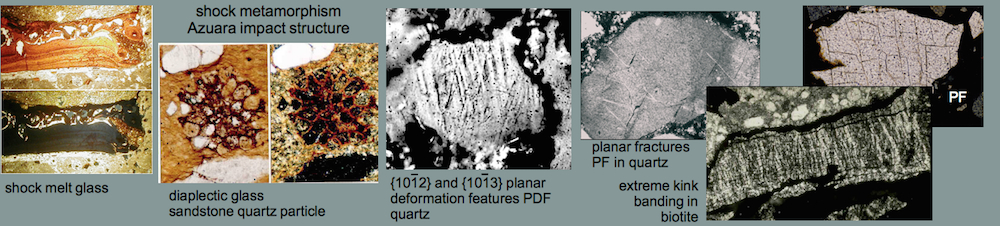
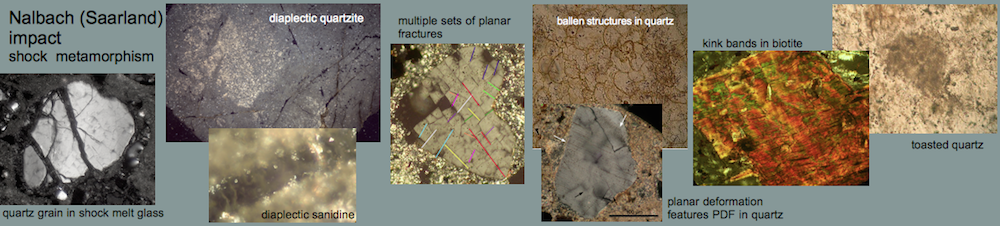
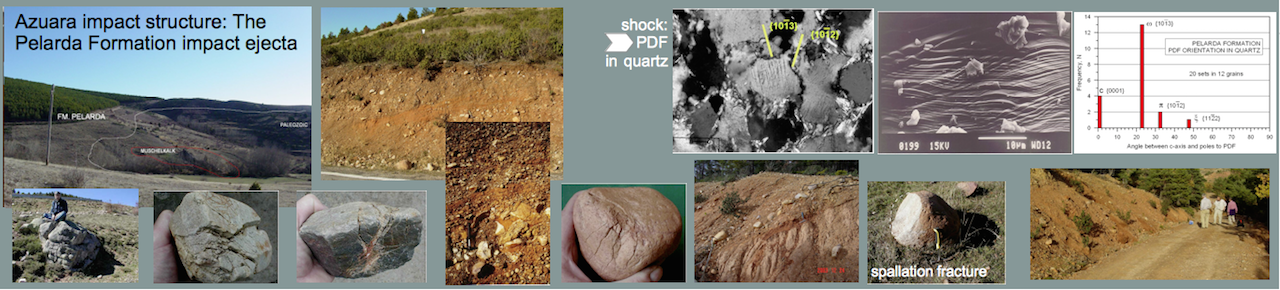
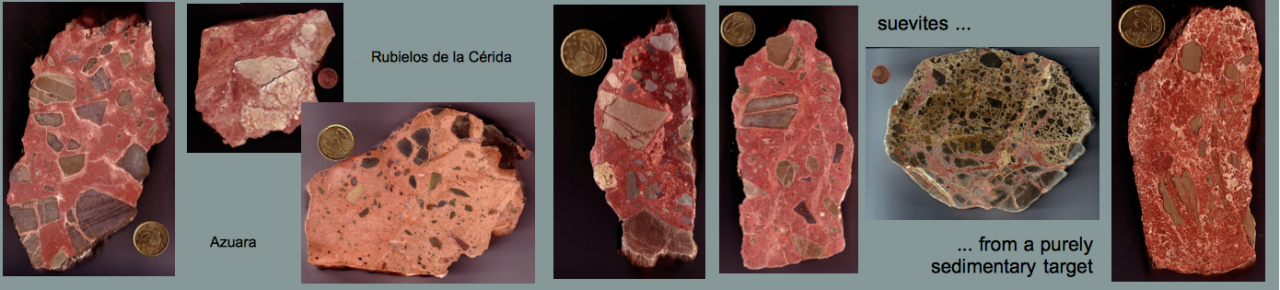
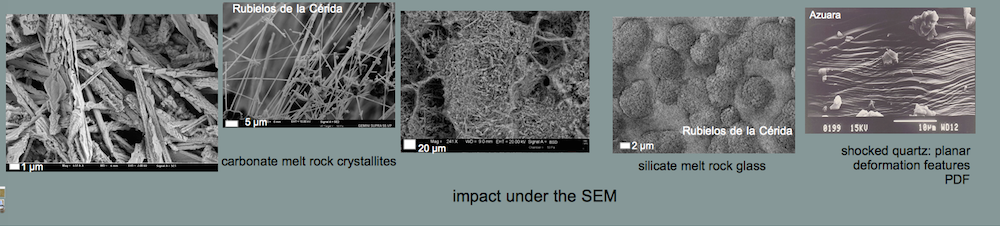
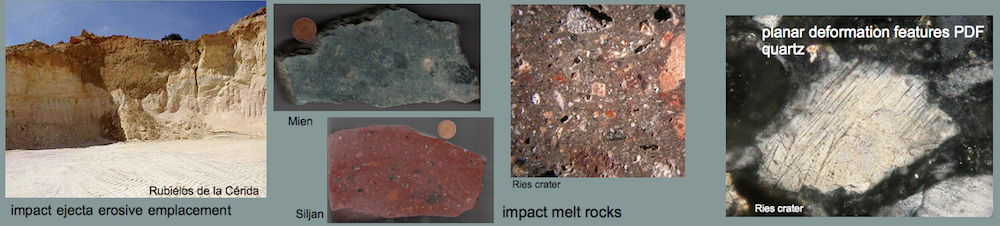
In an LPSC abstract article, Langenhorst & Deutsch (1996) pretend that there is no evidence for shock in the Azuara impact structure. They base their presumption on a TEM analysis of a sample taken by one of the present authors (K.E.) from the autochthonous rim of the Rubielos de la Cérida structure, but not in the Azuara structure (!). Moreover, Lagenhorst & Deutsch completely ignored the detailed description (given by K.E. to them) of the sample showing basal deformation lamellae and not PDFs (planar deformation features) and published the misleading results, although K.E. had informed them about their basic mistake. It is emphasized here that shock effects (diaplectic and melt glass, diaplectic crystals, PDFs, kink bands in mica, planar fractures in quartz) have always been reported (Ernstson et al. 1985, Fiebag 1988, Ernstson & Claudín 1990, Mayer 1991, Ernstson & Fiebag 1992, Ernstson 1994, and others) for polymict breccias within the Azuara structure and for the Pelarda Fm. impact ejecta only (see below). These papers, however, are not cited by Langenhorst and Deutsch in their LPSC paper.


Planar deformation features (PDFs) in quartz from the Pelarda formation ejecta. Left: Photomicrograph, crossed nicols. The crystallographical orientations of the sets are {10-13} and {10-12}. The field is 200 µm wide.

Right: SEM image of two sets of crossing PDFs. Note the spacing of the individual PDFs, which is distinctly less than 1 µm in many cases.


Left : Multiple sets of PDFs in quartz, Virgen de Herrera. Breccia sample, thin section, and photomicrograph: Alain Weissler (France - Société Astronomique de France, Commission des "Météorites, Impactisme, phénomènes lumineux").

Right: Multiple sets of PDFs in quartz; polymictic breccia, near Santa Cruz de Nogueras. The field is 140 µm wide.


Frequency diagram of crystallographic orientation of planar deformation features (PDFs) in quartz of sandstone components from Azuara mixed-breccia near Santa Cruz de Nogueras. The prominent and prevailing (10-13) and (10-12) orientations suggest shock pressures exceeding 10 GPa (= 100 kbar). The universal-stage measurements were made by Eugenio Guerrero Serrano at the Department of Petrology , Complutense University, Madrid. The frequency diagram is very similar to the diagram (see below) published in Earth and Planetary Science Letters by Ernstson et al. (1985).

A third and independent investigation of PDFs in samples from the Azuara impact structure (a polymict dike breccia and Pelarda Fm. ejecta) was made at the Geological Survey of Canada by Ann Thierrault. She analyzed the crystallographical orientation of PDFs in quartz and other parameters such as density, sharpness, spacing, and spreading over the grain. Up to five sets of PDFs per grain were observed. The spacing is 1 µm or less, the PDF density high. Practically all sets are decorated. All shocked grains have reduced birefringence of 0.004 - 0.008. A frequency diagram for the PDF crystallographical orientation is presented below. A comparison of the three analyses of the Azuara PDFs (by Kord Ernstson, Eugenio Guerrero, and Ann Thierrault) shows large similarities.

The prevailing {10-13} and {10-12} PDF orientations in the shocked samples from the Azuara structure are unusual considering the sedimentary (porous) target in which {11-22} and {10-11} directions commonly are more typical. The „crystalline“ signature of the Azuara PDFs, however, may be explained by the lithology of the target.

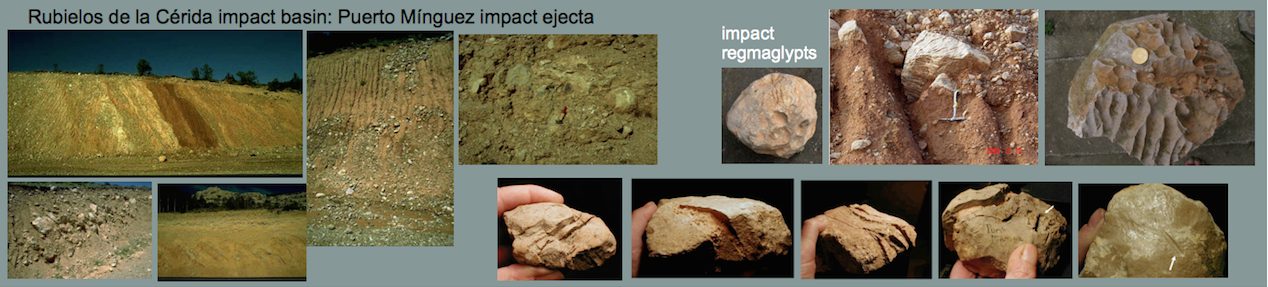
The impact affected a sedimentary column (several kilometers thick) composed of Paleozoic consolidated rocks (quartzites, phyllites, schists, and others), Mesozoic consolidated rocks (predominantly limestones), and Lower Tertiary unconsolidated rocks. The latter may be considered a molasse deposit of probably more than 1000 m thickness. It was composed of rocks originating from the erosion of the emerging Iberian Chain and, consequently, composed of dense Mesozoic and Paleozoic components. We suggest that the practically non-porous Paleozoic quartzites, phyllites, schists, and few granitoids, enabled the development of PDFs otherwise rather typical of crystalline targets (Stöffler et al. 1994, Grieve et al. 1996). Since these Palaozoic materials were preferentially sampled from the Pelarda Fm. ejecta and from breccia dikes and used for PDF universal-stage analyses, the prevailing orientations mentioned above may be understood. Therefore, we suggest that despite the high porosity of the deposit, the „crystalline“ PDF signature could develop, because, in the end, the material’s lithology is more important. This is a partially different view with regard to the paper of Grieve et al. (1996), although we basically share the authors’ opinion that lacking porosity and grain-size distribution are the leading factors.


By courtesy of G.Mayer

Partly isotropic quartz grain (diaplectic crystal) from a dike breccia. This shock deformation requires pressures exceeding 10 GPa (= 100 kb). Also note multiple sets of planar fractures as the probable result of shock. Photomicrograph, crossed nicols; the field is 195 µm wide.


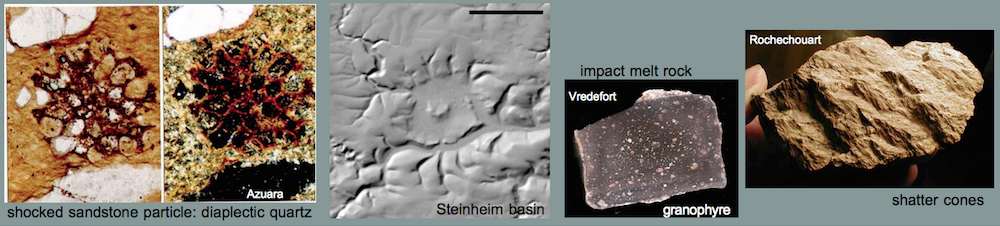
Diaplectic glass in a strongly shocked polymict breccia from the Azuara impact structure (Spain); photomicrograph. The sandstone fragment is composed of diaplectic quartz grains embedded within partly recrystallized silicate melt. Plane polarized light (left) and crossed nicols (right). Note that there are a few holes in the thin section not to be confused with diaplectic quartz grains. The field is 600 µm wide. - You will read and see more about the Azauara structure soon.


Quartz grain coated with melt-glass. Photomicrographs; crossed nicols (top left) and plane polarized light. From a strongly shocked polymict breccia; near Nogueras, Azuara impact structure. The field is 200 µm wide.


Photomicrograph (crossed nicols) of cleavage in quartz typical of shock-wave damage, but very uncommon in tectonically deformed quartz. Six sets of different orientation can be observed. Crystallographic planes (10-11) [a], (0001) [b], and (51-61) [c] are determined by universal stage measurements.

Azuara impact structure; sandstone fragment of a polymict breccia near Nogueras. The field is 450 µm wide .


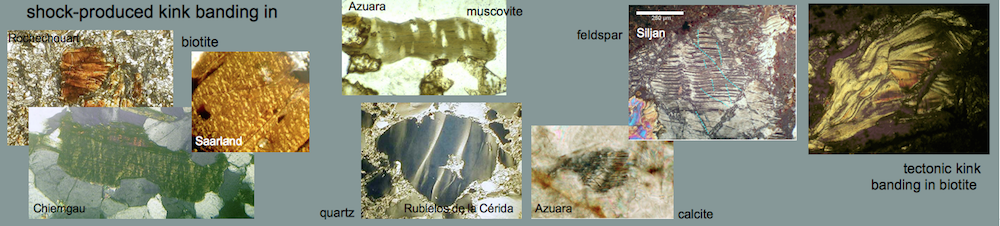
Kink bands in biotite from a highly shocked polymict breccia (Azuara impact structure, near Nogueras). Photomicrograph, crossed nicols; the field is 840 µm wide. - Although kink bands can be formed under static conditions of strong regional metamorphism, the high frequency of the kink bands shown here, their narrow width, and their high kink-angle asymmetry point to shock deformation.


Photomicrograph (crossed nicols) of pseudotachylite cutting quartz grains in a sandstone clast of a shocked polymict dike breccia. Note the minute offset alongside of the vein. Near Nogueras, Azuara impact structure. The field is 250 µm wide.


back ]
Partnersites:   www.ernstson.de    www.geophysik.de  
Please send questions to and comments on this website to:
  (Copy to the e-mail address bar please)  
fclaudin@xtec.net