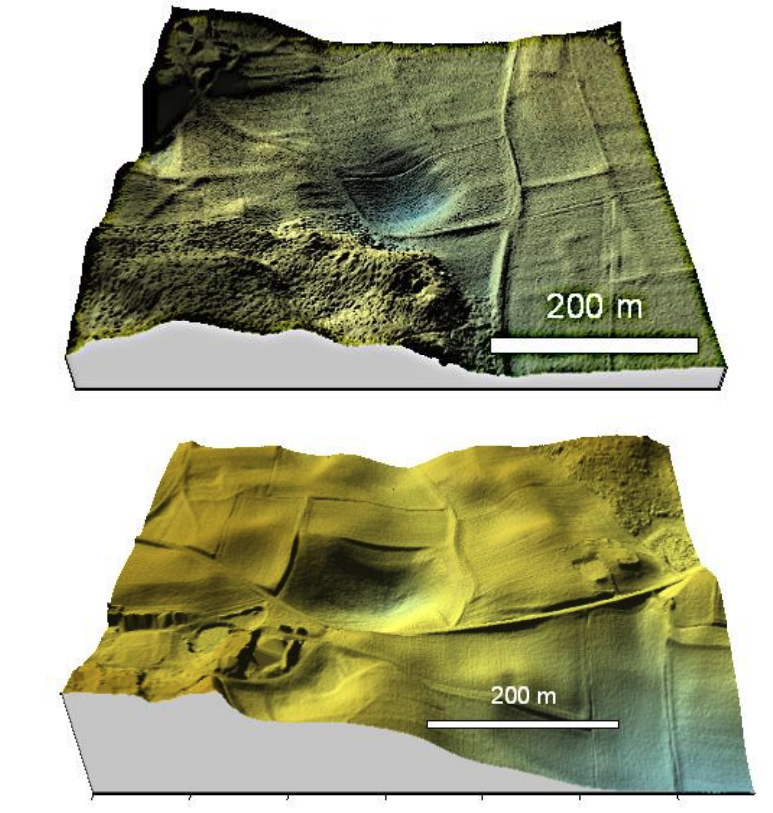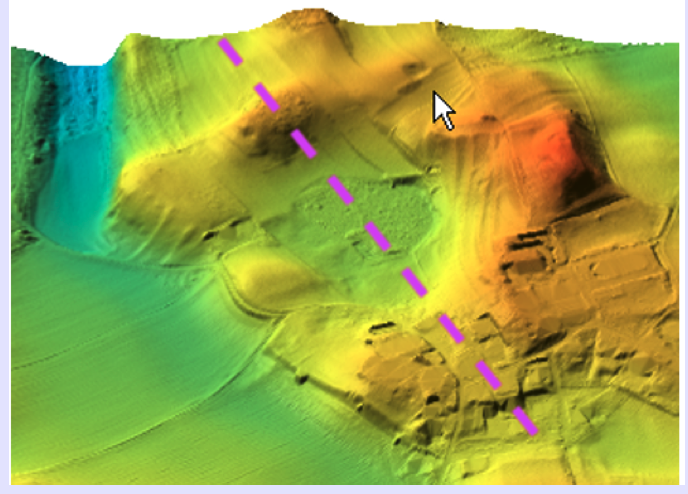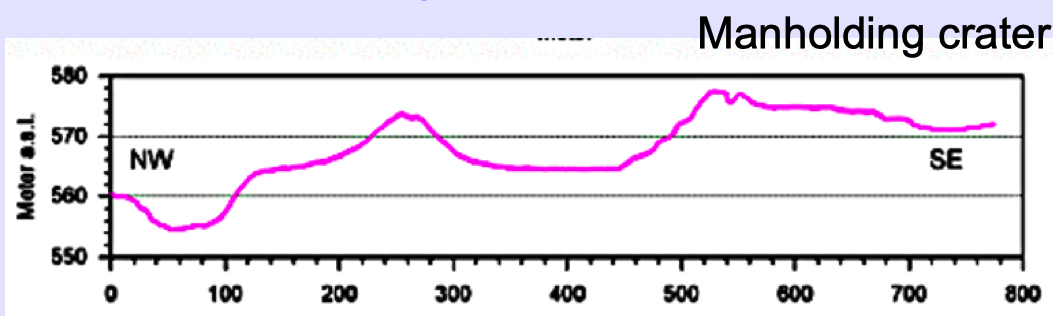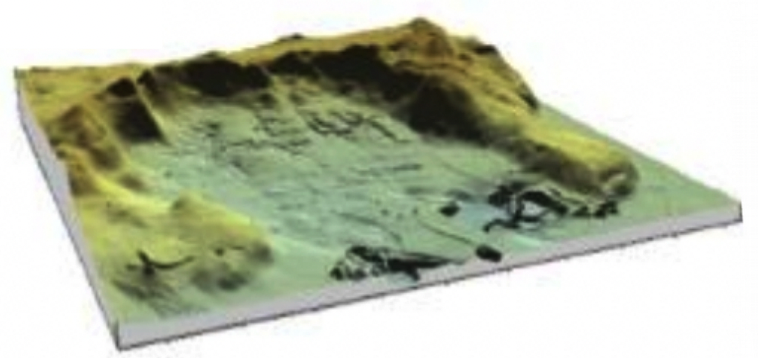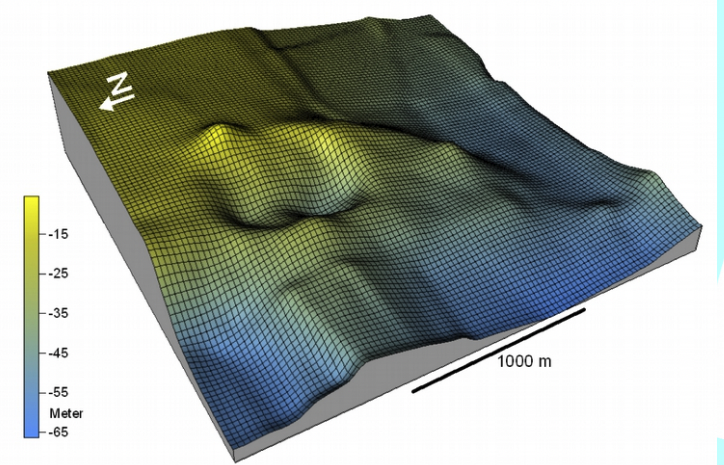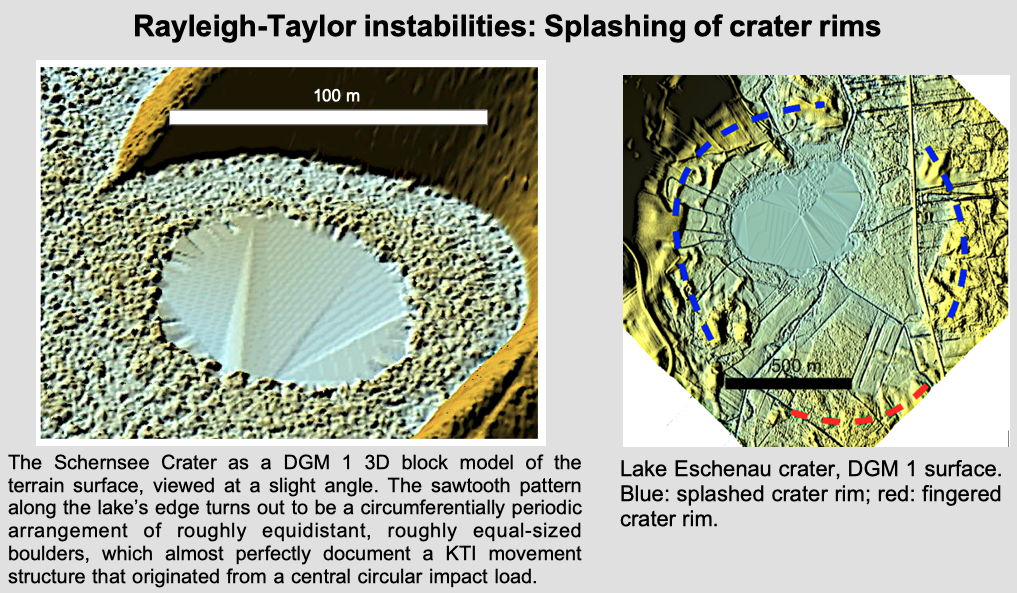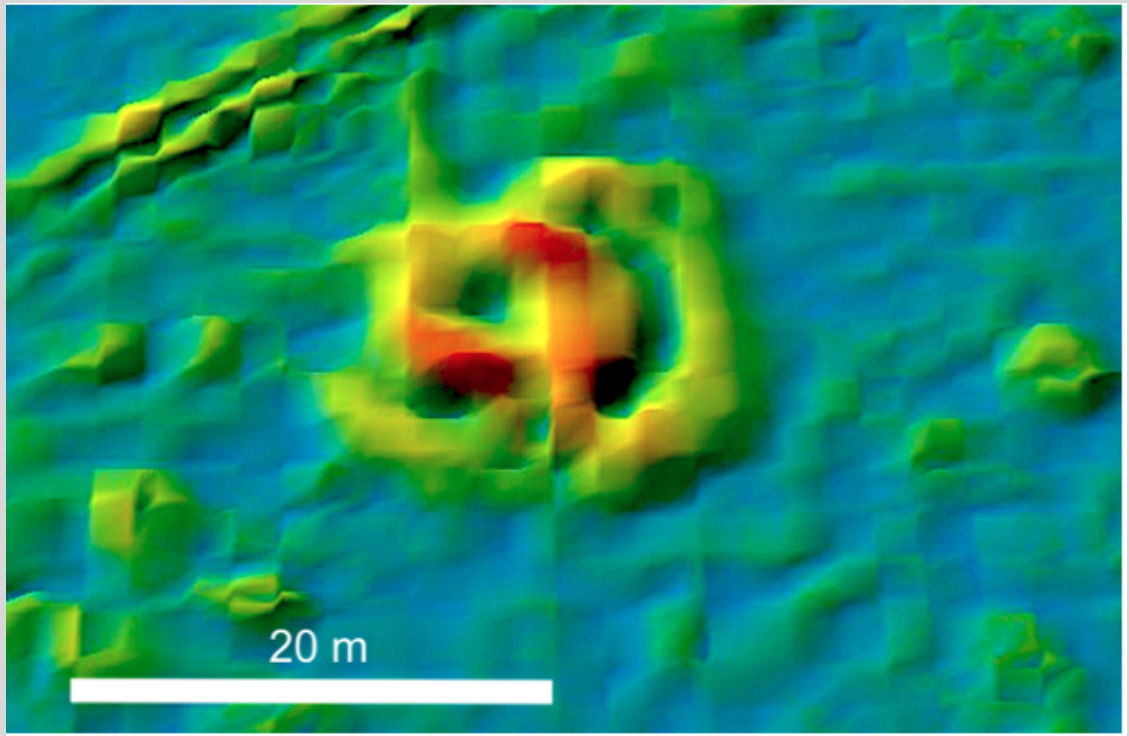
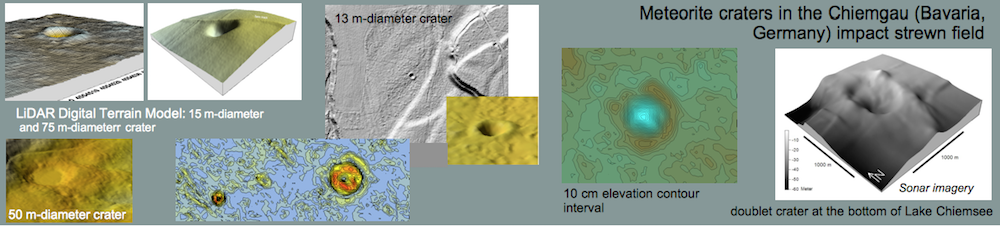

The crater Emmerting #004, Chiemgau airburst impact crater strewn field, as a high-resolution Digitale Terrain Model DGM 1. The wavy rim zone corresponds to the Kelvin-Helmholtz liquefaction impact model.
ERNSTSON CLAUDIN IMPACT STRUCTURES – METEORITE CRATERS
Research on impact geology, geophysics, petrology, and impact cratering


The crater Emmerting #004, Chiemgau airburst impact crater strewn field, as a high-resolution Digitale Terrain Model DGM 1. The wavy rim zone corresponds to the Kelvin-Helmholtz liquefaction impact model.

Click the article (translated from the German original)
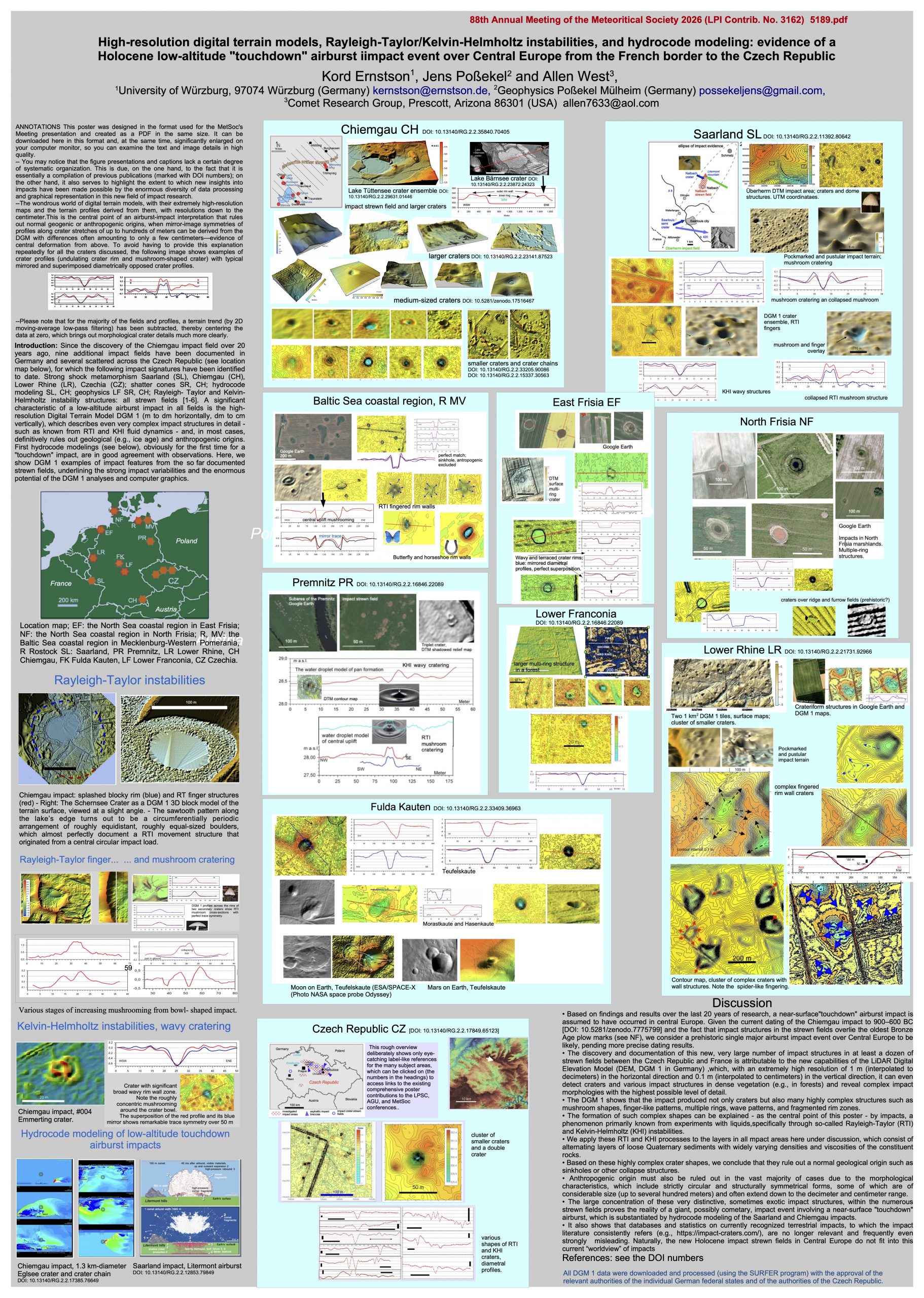
We present our findings on the Schlitzer Kauten in Hesse, Germany, revealing their complex structure as part of a larger impact feature field formed by a low-altitude touchdown airburst event. Our high-resolution digital terrain model DGM 1 has allowed us to rule out previous interpretations and connect these formations to similar Holocene events in Mid-Europe from the French border to the Czech Republic.
Please note that this article is a computer translation of the original German text and may contain incorrect wording.
Lake Bärnsee impact – Chiemgau impact strewn field – Impact research in the Czech Republic – Lake Tüttensee multiple impact – The Saarland impact and DTM – Viničky 100 km diameter impact structure in Slovakia
Kord Ernstson and Jens Poßekel
Poster Meteoritical Society Meeting 2025
*****************************************
Kord Ernstson and Jens Poßekel
Poster Meteoritical Society Meeting 2025
******************************************
The current state of impact research in the Czech Republic
Martin Molnár, Karel Ventura, Jens Poßekel and Kord Ernstson
Poster Meteoritical Society Meeting 2025
*****************************************
Jens Poßekel and Kord Ernstson
Poster 56th LPSC Meeting 2025, 2770.pdf
******************************************
Kord Ernstson, Werner Müller, Andreas Gawlik-Wagner, Kord Ernstson and Allen West
Poster 56th LPSC Meeting 2025, 1264.pdf
******************************************
Viničky: evidence of a 100 km impact structure in Slovakia
Kord Ernstson, Martin Molnár and Pavel Švanda
Poster 56th LPSC Meeting 2025, 1639.pdf
Earth Impact Database
Kord Ernstson, Jens Poßekel, Karel Ventura, and Martin Molnár
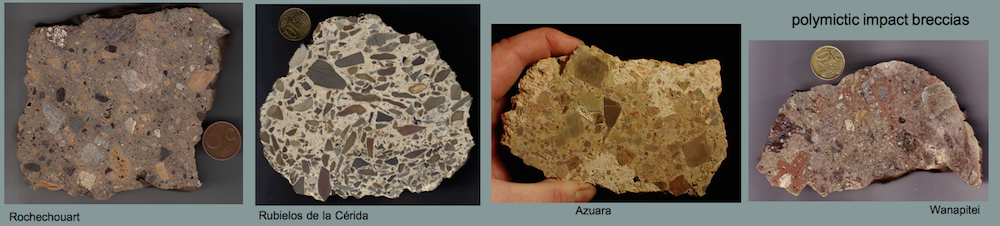
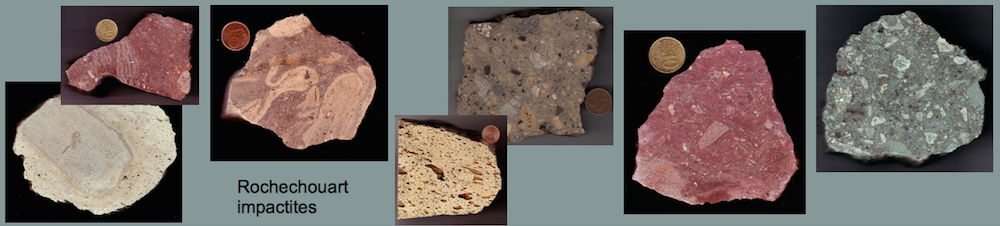
Abstract: We report an unusual polymict melt rock megabreccia in the form of an allochthonous non-volcanic megablock within the Tertiary volcanic province of the Bohemian Massif. It is considered a relict of a suspected low-altitude airburst impact.
F.M. Claudin and K. Ernstson
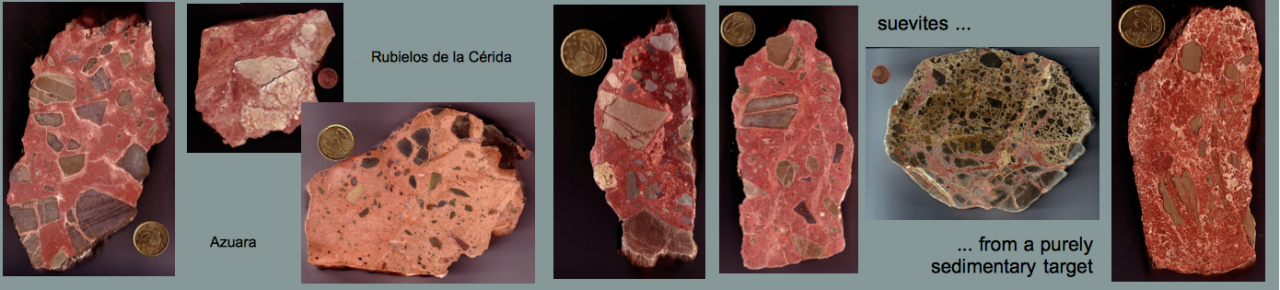
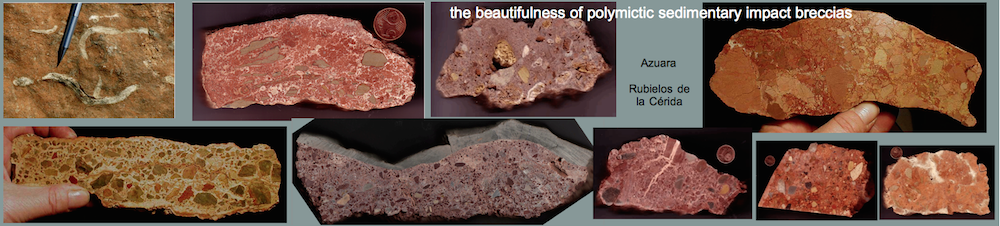
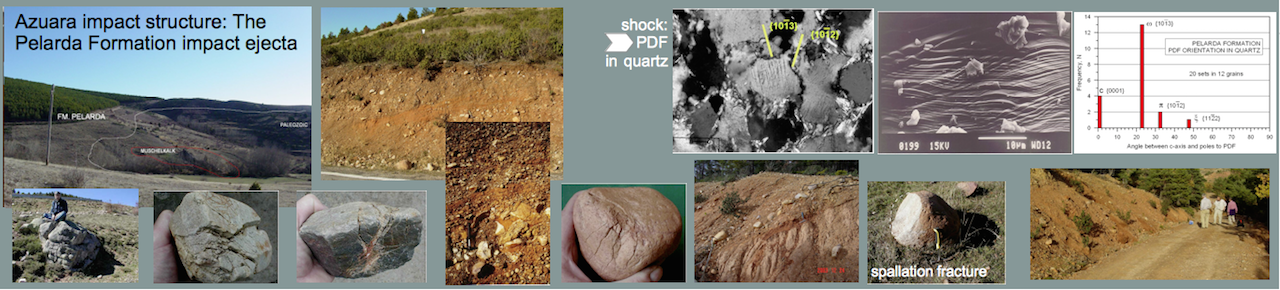
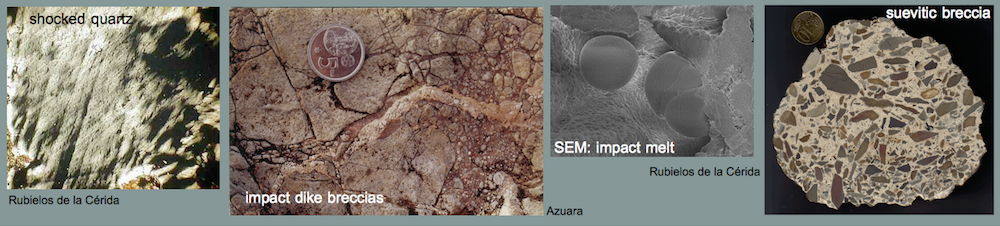
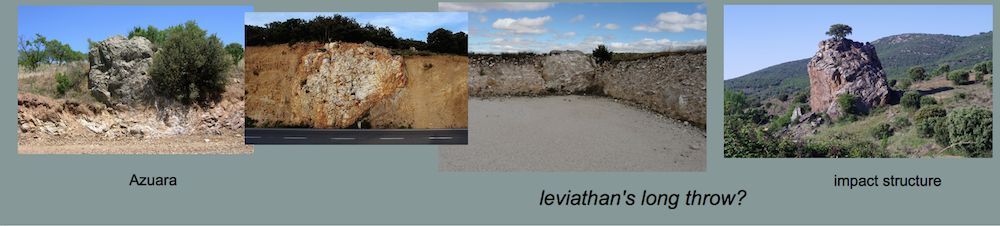
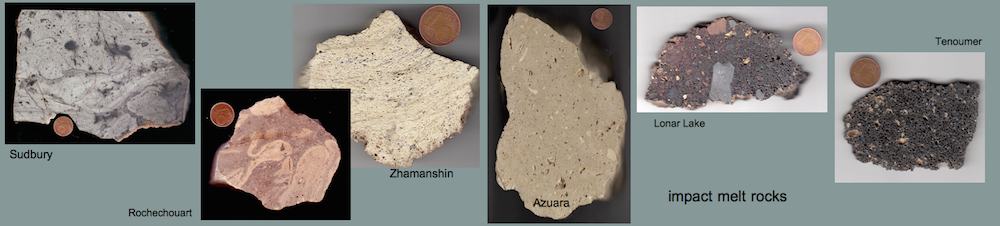
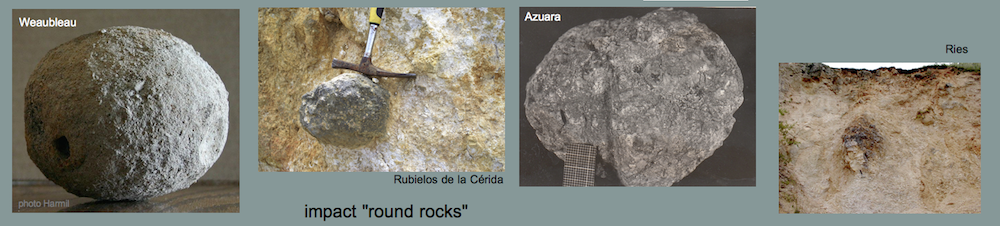
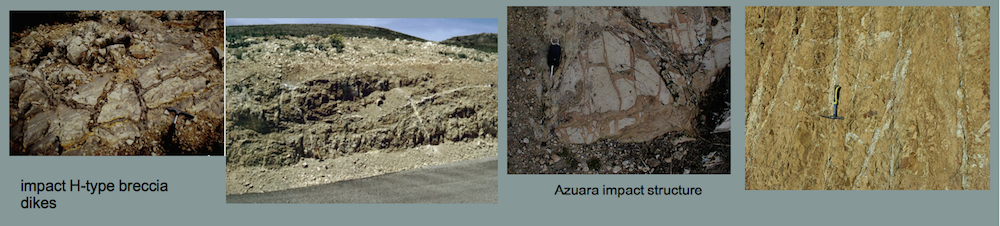
Abstract: We report on the mid-Tertiary multiple Azuara impact event (Spain) with the Azuara impact structure and the Rubielos de la Cérida impact basin and the chequered history of their discovery and their place in impact research.
A peer-reviewed journal collection covering all aspects of airbursts and impacts on Earth by Comets and Asteroids – Click the image to enter this new world of impact research.
Under the auspices of the ScienceOpen platform, this new journal provides a publication forum that is arguably unparalleled within the global impact research community. Designed as an open access journal with free access to any size readership, this journal for high quality contributions is a response to what a new report (1/4/2023) in the journal NATURE described as a sharp increase in the number of purely scientific and technical articles in recent decades, with a drastic decline in submitted articles pointing in new, exciting, “disruptive” directions. This development is unfortunately accompanied by increasingly incompetent and partially manipulated peer review processes, for which there is some thought-provoking evidence directly addressed here. What expresses this alarming development better than that at MDPI journals the Editorial Board at Minerals, for example, has 405 members and the Reviewer Board 274 members, and at Geosciences 300 members occupy the Editorial Board and 198 members the Topical Advisory Panel.
This new journal will have a different character, and a detailed introduction and overview (aims and scope, article submission, published articles statistics, peer review processes, and more) is provided by clicking on the image above. A special feature is already added here that the journal also consideres quality posters and iPosters accepted from meetings (e.g. LPSC, AGU Fall Meeting, MetSoc Meeting) for publication in this journal.
The ugly side of Peer Review.
The guest editors of the Special Issue on terrestrial meteoritic impacts and impact structures, Prof. Dr. Kord Ernstson (Editor-in-Chief), Dr. Allen West, Dr. Gerhard Schmidt (Co-Editors) have terminated their collaboration with the MDPI Journal GEOSCIENCES with immediate effect (with confirmation from MDPI). The reason is intolerable and ugly manipulation of the peer review process for research articles submitted for the special issue. Thereafter, unchallenged by Geosciences, external intervention (almost certainly from the so-called narrower “impact community”) occurred in the virtually positively terminated review process of several articles with a final REJECT by the Geosciences Academic Editorial, without a single word of notice to us as responsible editors of the Special Issue.
This practice, massively violated against all scientific ethics (which MDPI apparently holds so high), has become intolerable for us. The four research articles already announced for the Special Issue are in preparation for a more honest publication organ.
People experienced the prehistoric Chiemgau meteorite impact – geoarchaelogical evidence from southeastern Germany: a review
Barbara Rappenglück, Michael Hiltl, Jens Poßekel, Michael Rappenglück, Kord Ernstson
Mediterranean Archaeology and Archaeometry, 23, No. 1, 209-234, 2023.
http://maajournal.com/Issues/2023/Vol23-1/8_Rappengluck_et_al_23(1).pdf (full article free open access)
Abstract. – Archaeological sites undoubtedly destroyed by a meteorite impact had not been identified so far. For such a proof, both a meteorite impact and its definite effects on an archaeological site would have to be evidenced. This review article reports on geoarchaeological investigations, involving mineralogy, petrography, and geophysics, which established evidence that two prehistoric human settlements have been affected by the Late Bronze Age/Early Iron Age (ca. 900-600 BC) Chiemgau meteorite impact in southeastern Germany. One site, the Mühlbach area, was affected by the ejecta from the 600 m Ø-Tüttensee crater, one of the largest craters in a crater strewn field measuring about 60 x 30 km. At the other site, Stöttham close to Lake Chiemsee, the catastrophic layer of the impact was found embedded in the archaeological stratigraphy of a settlement, which had been repeatedly occupied from the Neolithic to the Roman era. At both sites, artifacts have become components of impact rocks, establishing a hitherto unknown form of an impact rock, an artifact-in-impactite. The immediate coexistence of rocks, which exhibit impact-diagnostic shock metamorphism, with relicts of metallic artifacts, as encountered in finds from Stöttham, are unprecedented evidence of human experience of a meteorite impact.
Pingos and mardels: high-resolution digital terrain models suggest meteorite impact craters in addition to permafrost, sinkhole and dead-ice formation models.
Kord Ernstson1 and Jens Poßekel2
Abstract. – With the meanwhile widely available data of Digital Terrain Models (DTM) with extremely high resolution of the bare terrain surface, vertically and horizontally, down to the decimeter and centimeter range and freed from buildings and any vegetation, completely new possibilities have opened up in the geosciences, which entail paradigm shifts in established ideas and textbook wisdom. Such a paradigm shift is especially indicated in ice age research and more generally in the still open discussion of the formation of smaller terrain forms in the manner of general and diverse depressions. With the new possibilities of the DTM a new “contender” has entered the discussion, which was already considered as a cause sporadically in former times, since relatively short time with the extreme terrain resolution of the DTM has led to completely new ways of consideration. This article reports about it with the finding that impact craters may be the more reasonable explanation for previously assumed pingos, mardels in the general sense, and dead ice holes.
Keywords: Pingo, mardel, sinkhole, dead ice hole, meteorite crater, impact crater strewn field, impact airburst
____________________________________________
1University of Würzburg, D-97074 Würzburg, Germany, kernstson@ernstson.de; 2Geophysik Poßekel Mülheim, Germany, jens.possekel@cityweb.de.
1 Introduction
Pingos are mounds of earth formed in permafrost. The interior of the mound consists of an ice core, and they have a circular or oval shape and can reach a diameter of up to several hundred meters and a height of up to several dekameters. When the ice core melts, the pingo collapses and forms a depression in the ground called a pingo ruin. A common explanation of ice core formation is artesian rising warmer waters in the permafrost, which freeze there and are successively pushed further and further up as a massive core.
Continue reading “New Article: Pingos, Mardels and Meteorite Impact Craters”