

Kord Ernstson 1 and Jens Poßekel 2
Abstract.- We comment with a few sentences on an article by the three authors, which casts a pretty bad light on the Meteoritical Society and its journal Meteoritics and Planetary Science and lets guess why this survived the peer review of the journal and did not end up in the trash.
______________________________
1University of Würzburg, 97074 Würzburg (Germany) kernstson@ernstson.de, 2Geophysics Poßekel Mülheim (Germany) possekeljens@gmail.com.
1 Introduction
The open-access article published in the latest issue of MAPS by Huber, Lauterbach and Darga, with the peer reviewers Reimold and Boslough, and editorial handling by C. Koeberl, is at such a low level that was never expected from the renowned journal of the Meteoritical Society. The authors, a former marine geologist and now a manager of science data, a non-scientific private person, and a glacial geologist, have never worked on meteoritic impacts and impact-research topics of impact geology, impact geophysics, impact mineralogy/petrography, impact geochemistry, shock metamorphism, crater formation processes, and impact fracture mechanics, and certainly have not published seriously. Their article is currently their final point under almost 20 years of bitter, partly polemical attempts to describe the world’s most important Holocene impact event (see the publication list below) as non-existent and a myth. The fact that some impact databases continue to ignore this does not make things better or more convincing.
2 Short scathing review
The article by Huber, Lauterbach and Darga is so wrong, abstruse and misleading that we completely refrain from opposing a further comment or a reply, as is usually appreciated in science. We refer only to the references, in which no more than four (4) contributions by Chiemgau researchers are listed. Instead, we refer to the following list of previous publications on the Chiemgau impact from the past 20 years.
3 The list of previous 55 (fifty-five) publications on the Chiemgau impact
The following list can also be downloaded as a PDF. Most of the articles are also DOI-clickable and can be read online.
4 Discussion
The discussion can also remain short after the previous remarks. 20 years of research on the Chiemgau impact, with completely new findings on low-altitude touchdown airburst impacts and an imposing paradigm shift in impact research, show how absurd the article-fairytale narration of the authors Huber, Lauterbach and Darga is. It is incomprehensible that the editor-in-chief of Meteoritics and Planetary Science let this go through, presumably in reliance on peer reviewers Reimold and Boslough, and the handling editor C. Koeberl, which is not a page of glory for the journal. For the current author K.E., the pressing question arises, and he seriously considers whether he will, after approx. 40 years or more of membership in the society terminates it, if such a thing is possible in their official journal, especially since earlier there were several reasons for K.E. to perceive contributions by well-known impact authors who have appeared in the journal as discrediting impact researcher colleagues, and to spot other questionable impact articles “waved through“ by the editors.
Peer-reviewed articles
- Rappenglück, B., Hiltl, M., Poßekel, J., Rappenglück, M. A., Ernstson, K. (2023) People experienced the prehistoric Chiemgau meteorite impact – geoarchaeological evidence from southeastern Germany: a review. Mediterranean Archaeology and Archaeometry 23, no. 1, 1209-234. https://doi.org/10.5281/zenodo.7775799
- Ernstson, K., Bauer, F., Hiltl, M. (2023) A Prominent Iron Silicides Strewn Field and Its Relation to the Bronze Age/Iron Age Chiemgau Meteorite Impact Event (Germany). Earth Sciences. Vol. 12, No. 1, 26-40. https://doi.org/10.11648/j.earth.20231201.14
- Rappenglück, M. A. (2022) Natural Iron Silicides: A Systematic Review. Minerals, Vol. 12, No. 2, p. 188. https://doi.org/10.3390/min12020188
- Rappenglück, B., Hiltl, M., Ernstson, K. (2021) The Chiemgau Impact: evidence of a Latest Bronze Age/Early Iron Age meteorite impact in the archaeological record, and resulting critical considerations of catastrophism. – In: A. César González-García, Roslyn M. Frank, Lionel D. Sims, Michael A. Rappenglück, Georg Zotti, Juan A. Belmonte, Ivan Šprajc (eds.), Beyond Paradigms in Cultural Astronomy (BAR International Series 3033), Oxford, 57-64.
- Rappenglück, B., Hiltl, M., Rappenglück, M. A., Ernstson, K. (2020b) The Chiemgau Impact — a meteorite impact in the Bronze/Iron Age and its extraordinary appearance in the archaeological record. – In: G. Wolfschmidt (ed.) Himmelswelten und Kosmovisionen — Imaginationen, Modelle, Weltanschauungen: Proceedings der Tagung der Gesellschaft für Archäoastronomie in Gilching, 29.–31. März 2019, Hamburg: tredition, 330–349.
- Rappenglück, B., Hiltl, M., Ernstson, K. (2020a): Exceptional evidence of a meteorite impact at the archaeological site of Stöttham (Chiemgau, SE-Germany). – In: S. Draxler, M. Lippitsch, G. Wolfschmidt (eds.) Harmony and Symmetrie. Celestial regularities shaping human cultures: Proceedings of the 26th Annual Meeting of the European Society of Astronomy in Culture, August 27 – September 2018, Graz, Hamburg: tredition, 116-125.
- Shumilova, T. G., Isaenko, S. I., Ulyashev, V. V., Makeev, B. A., Rappenglück, M. A., Veligzhanin, A. A., Ernstson, K. (2018): Enigmatic Glass-Like Carbon from the Alpine Foreland, Southeast Germany: A Natural Carbonization Process. – Acta Geologica Sinica (English Edition), Vol. 92, Issue 6, 2179-2200. https://onlinelibrary.wiley.com/doi/10.1111/1755-6724.13722
- Rappenglück, M., Rappenglück, B., Ernstson, K. (2017) Kosmische Kollision in der Frühgeschichte. Der Chiemgau-Impakt: Die Erforschung eines bayerischen Meteoritenkrater-Streufelds. – Zeitschrift für Anomalistik, 17, 235-260.
- Rappenglück, B. (2013) Myths and motifs as reflections of prehistoric cosmic events: some methodological considerations. – In: I. Šprajc and P. Pehani (eds), Ancient cosmologies and modern prophets. Proceedings of the SEAC 2012 conference. Ljubljana: Slovene Anthropological Society (= Anthropological Notebooks year XIX, supplement), 67-83.
- Ernstson, K., Sideris, C., Liritzis, I., Neumair, A. (2012) The Chiemgau meteorite impact signature of the Stöttham archaeological site (Southeast Germany). – Mediterranean Archaeology and Archaeometry, 12, no. 2, 249-259. https://www.maajournal.com/index.php/maa/article/view/494
- Ernstson, K., Mayer, W., Neumair, A., Sudhaus, D. (2011) The sinkhole enigma in the Alpine Foreland, Southeast Germany: Evidence of impact-induced rock liquefaction processes. – Central European Journal of Geosciences 3, no. 4, 385-397. https://doi.org/10.2478/s13533-011-0038-y
- Liritzis, I., Zacharias, N., Polymeris, G. S., Kitis, G., Ernstson, K., Sudhaus, D., Neumair, A., Mayer, W., Rappenglück, M. A., Rappenglück, B. (2010) The Chiemgau meteorite impact and tsunami event (Southeast Germany): First OSL dating. – Mediterranean Archaeology and Archaeometry, 10, no. 4, 17-33.
- Rappenglück, B., Rappenglück, M. A., Ernstson, K., Mayer, W., Neumair, A., Sudhaus, D., Liritzis, I. (2010) The fall of Phaethon: a Greco-Roman geomyth preserves the memory of a meteorite impact in Bavaria (south-east Germany). – Antiquity, 84, 428-439. https://doi.org/10.1017/S0003598X00066680
- Ernstson, K., Mayer, W., Neumair, A., Rappenglück, B., Rappenglück, M.A., Sudhaus, D., Zeller, K.W. (2010) The Chiemgau crater strewn field: evidence of a Holocene large impact in southeast Bavaria, Germany. – Journal of Siberian Federal University, Engineering & Technology, 1 (3), 72-103.
- Rappenglück, B., Ernstson, K., Mayer, W., Neumair, A., Rappenglück, M.A., Sudhaus, D., Zeller, K.W. (2009) The Chiemgau impact: An extraordinary case study for the question of Holocene meteorite impacts and their cultural implications. – In: Belmonte, J. A. (ed.), Proceedings of the International Conference on Archaeoastronomy, SEAC 16th 2008 “Cosmology across Cultures. Impact of the Study of the Universe in Human Thinking”, Granada September 8-12, 2008, A.S.P. Conf. Ser., 2009.
- Rappenglück, B., Rappenglück, M. (2006) . – Mediterranean Archaeology and Archaeometry, 6, no. 3, 101-109. https://www.maajournal.com/index.php/maa/article/view/170/125
Abstracts and Posters, Conferences: LPSC, MetSoc, AGU, PCC
- Rappenglück, M. A., Rappenglück B. (2026) Towards a Methodological Validation of Digital Terrain Models as a Potential Impact Criterion: Requirements, Constraints, and a Roadmap for Empirical Testing. – 57th Lunar & Planetary Science Conference 2026, #1078. https://www.hou.usra.edu/meetings/lpsc2026/pdf/1078.pdf
- West, A., Ernstson, K. (2026) Hydrocode modeling of impact craters: Chiemgau low-altitude airburst impact strewn field, Germany. – 57th Lunar & Planetary Science Conference 2026, #1085. https://www.hou.usra.edu/meetings/lpsc2026/pdf/1085.pdf
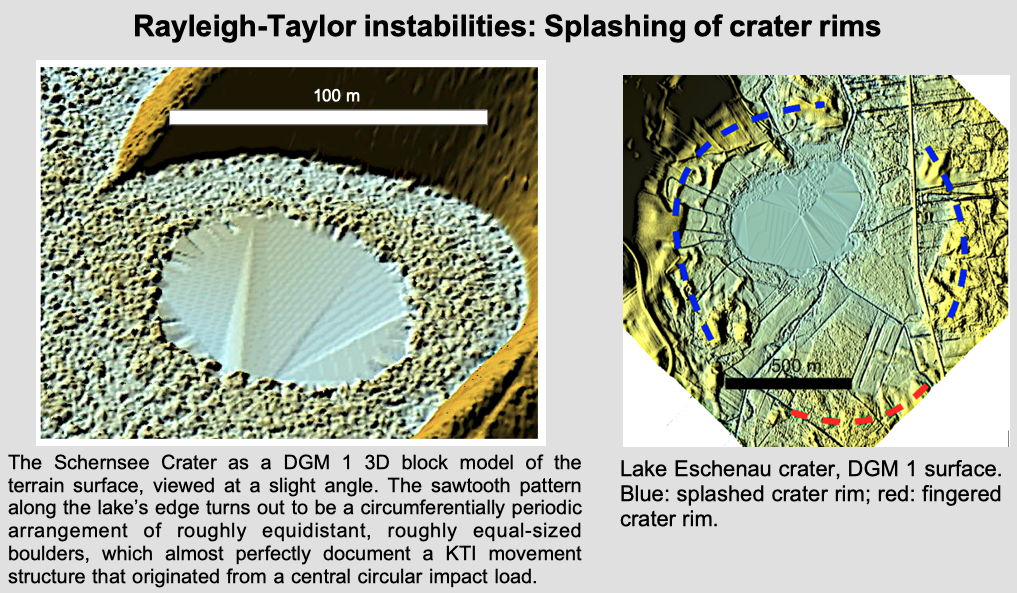
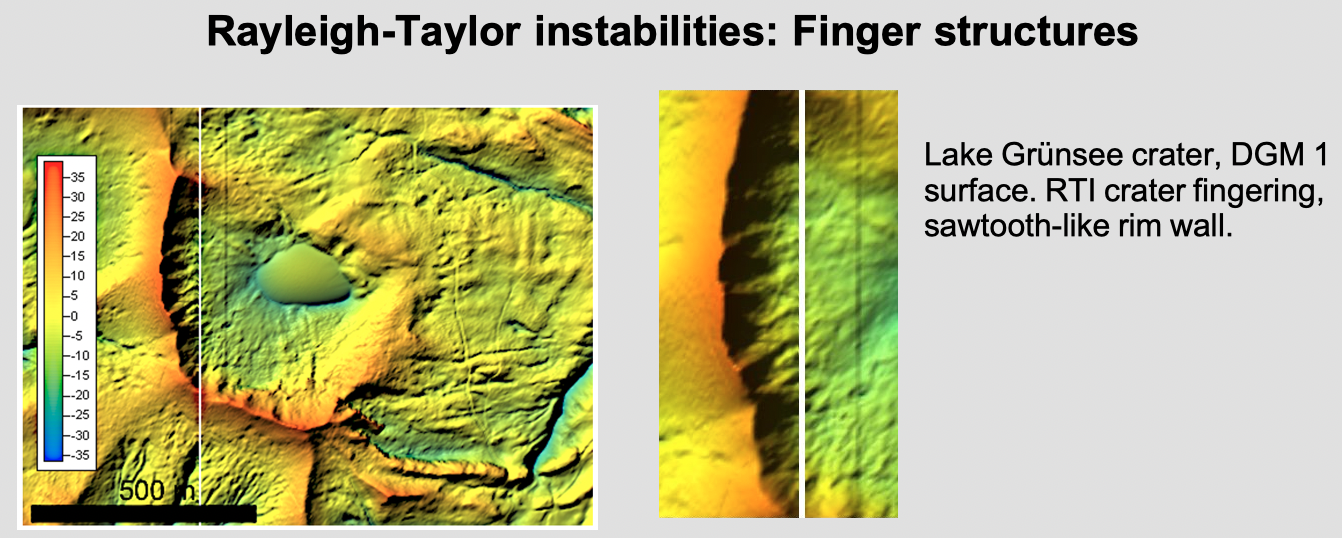
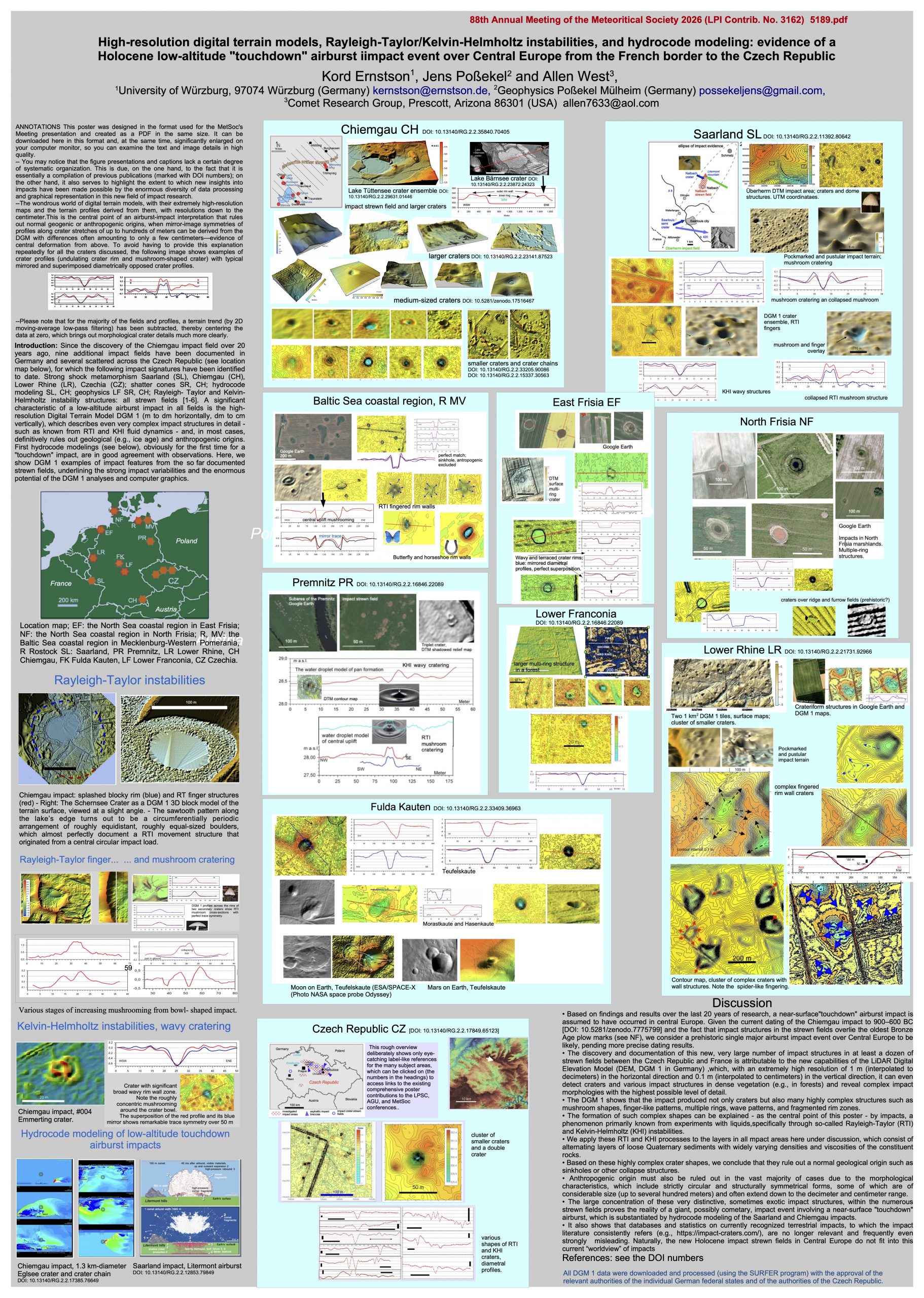
- Ernstson, K., Poßekel, J., West, A. (2026) High-resolution digital terrain models DTM: Rayleigh-Taylor and Kelvin-Helmholtz instabilities and impact cratering in unhardened loose sediments – the Holocene Chiemgau airburst impact case. – 57th Lunar & Planetary Science Conference 2026, #1084. https://www.hou.usra.edu/meetings/lpsc2026/pdf/1084.pdf
- Ernstson, K., Poßekel, J. (2025) High-resolution Digital Terrain Models (DTM): a new approach to impact cratering. – American Geophysical Union (AGU) Fall Meeting 2025.
- Ernstson, K., Poßekel, J. (2025) Lake Bärnsee in the Chiemgau Holocene impact strewn field (Germany): ice-age tongue basin lake vs. Holocene low-altitude touchdown airburst impact formation. – Meteoritical Society Meeting 2025, DOI: 10.13140/RG.2.2.23872.24323.
- Ernstson, K., Poßekel, J. (2025) Many of a kind: the Digital Terrain Model and a new cluster of larger and smaller craters accumulate the Chiemgau meteorite impact strewn field. – Meteoritical Society Meeting 2025, DOI: 10.13140/RG.2.2.27227.68642.
- Poßekel, J., Ernstson, K. (2025) The Digital Terrain Model: New Insights into the Holocene Lake Tüttensee (Germany) Multiple Impact Structure as Part of the Chiemgau Low Altitude Touchdown Airburst Event. – 56th Lunar & Planetary Science Conference 2025, DOI: 10.13140/RG.2.2.29631.01446.
- Ernstson, K., Poßekel, J. (2024) The Chiemgau Meteorite Impact Strewn Field and the Digital Terrain Model: “Earthquake” Liquefaction from Above and from Below. – American Geophysical Union (AGU) Fall Meeting 2024, DOI: 10.13140/RG.2.2.11274.79041.
- Ernstson, K., Poßekel, J. (2024) Paradigm Shift in Impact Research: The Holocene Chiemgau Meteorite Impact Crater Strewn Field and the Digital Terrain Model. – Lunar & Planetary Science Conference LPSC 2024, DOI: 10.13140/RG.2.2.33205.90086.
- Ernstson, K., Poßekel, J., Rappenglück, M. A. (2024) Mars and Moon on Earth: Multiple Impact and Oblique Impact Patterns from Digital Terrain Models in the Holocene Chiemgau Crater Strewn Field. – Lunar & Planetary Science Conference LPSC 2024, DOI: 10.13140/RG.2.2.23585.21604.
- Rappenglück, M. A., Poßekel, J., Ernstson, K. (2021) Mars and Moon on Earth: formation of small terraced impact craters and ground-penetrating radar investigations. – 12th Planetary Crater Consortium Meeting 2021.
- Ernstson, K., Poßekel, J. (2020) Digital Terrain Model (DTM) topography of small craters in the Holocene Chiemgau (Germany) meteorite impact strewn field. – Conference 11th Planetary Crater Consortium 2020 (LPI Contrib. No. 2251).
- Poßekel, J., Ernstson, K. (2019) Anatomy of Young Meteorite Craters in a Soft Target (Chiemgau Impact Strewn Field, SE Germany) from Ground Penetrating Radar (GPR) Measurements. – 50th Lunar & Planetary Science Conference 2019, DOI: 10.13140/RG.2.2.14155.64802.
- Ernstson, K., Poßekel, J. (2020) Complex Impact Cratering in a Soft Target: Evidence from Ground Penetrating Radar (GPR) for Three Structures in the Chiemgau Meteorite Impact Strewn Field, SE Germany (1.3 km-Diameter Eglsee, 250 m-Diameter Riederting, 60 m-Diameter Aiching). – American Geophysical Union (AGU) Fall Meeting 2020, online, 1-17 Dec., Abstract EP036-0005. https://agu.confex.com/agu/fm20/meetingapp.cgi/Paper/677731
- Bauer, F., Hiltl, M., Rappenglück, M. A., Ernstson, K. (2020) An eight-kilogram chunk and more: evidence for a new class of iron silicide meteorites from the Chiemgau impact strewn field (SE Germany). – Modern Problems of Theoretical, Experimental, and Applied Mineralogy (Yushkin Readings – 7-10 December 2020, Syktyvkar, Russia), Proceedings, 359-360.
- Ernstson, K., Shumilova, T. G. (2020) Chiemite — a high PT carbon impactite from shock coalification/carbonization of impact target vegetation. – Modern Problems of Theoretical, Experimental, and Applied Mineralogy (Yushkin Readings – 7-10 December 2020, Syktyvkar, Russia), Proceedings, 363-365.
- Rappenglück, B., Hiltl, M., Ernstson, K. (2020) Artifact-in-impactite: a new kind of impact rock. Evidence from the Chiemgau meteorite impact in southeast Germany. – Modern Problems of Theoretical, Experimental, and Applied Mineralogy (Yushkin Readings – 7-10 December 2020, Syktyvkar, Russia), Proceedings, 365-367.
- Poßekel, J., Ernstson, K. (2020) Not just a rimmed bowl: Ground penetrating radar (GPR) imagery of small craters in the Holocene Chiemgau (Germany) meteorite impact strewnfield. – 11th Planetary Crater Consortium 2020 (LPI Contrib. 2251), Abstract #2014.
- Ernstson, K., Poßekel, J. (2020) Digital terrain model (DTM) topography of small craters in the Holocene Chiemgau (Germany) meteorite impact strewnfield. – 11th Planetary Crater Consortium 2020 (LPI Contrib. 2251), Abstract #2019.
- Ernstson, K., Poßekel, J., Rappenglück, M. A. (2020) Near-ground airburst cratering: petrographic and ground-penetrating radar (GPR) evidence for a possibly enlarged Chiemgau Impact event (Bavaria, SE-Germany). – 50th Lunar and Planetary Science Conference, Poster, Abstract #1231. Abstract, Poster
- Poßekel, J., Ernstson, K. (2019) Anatomy of Young Meteorite Craters in a Soft Target (Chiemgau Impact Strewn Field, SE Germany) from Ground Penetrating Radar (GPR) Measurements. – 50th Lunar and Planetary Science Conference, Abstract #1204, LPI Contrib. 2132. Poster
- F. Bauer, M. Hiltl, M.A. Rappenglück, K. Ernstson (2019): Trigonal and Cubic FE2SI Polymorphs (Hapkeite) in the Eight Kilograms Find of Natural Iron Silicide from Grabenstätt (Chiemgau, Southeast Germany). – 50th Lunar and Planetary Science Conference, Poster, Abstract #1520, LPI Contrib. 2132. Abstract, Poster
- Rappenglück, B., Hiltl, M., Ernstson, K. (2019) Metallic Artifact Remnants in a Shock-Metamorphosed Impact Breccia: an Extended View of the Archeological Excavation at Stöttham (Chiemgau, SE-Germany). – 50th Lunar and Planetary Science Conference, Poster, Abstract #1334, LPI Contrib. 2132. Abstract, Poster
- Ernstson, K., Poßekel, J. (2017) Meteorite Impact „Earthquake“ Features (Rock Liquefaction, Surface Wave Deformations, Seismites) from Ground Penetrating Radar (GPR) and Geoelectric Complex Resistivity/Induced Polarization (IP) Measurements, Chiemgau (Alpine Foreland, Southeast Germany). – American Geophysical Union (AGU) Fall Meeting 2017, New Orleans, 11-15 Dec. Abstract EP53B-1700.
- Ernstson, K. (2016) Evidence of a meteorite impact-induced tsunami in lake Chiemsee (Southeast Germany) strengthened. – 47th Lunar and Planetary Science Conference. Abstract.
- Rappenglück, M. A., Bauer, F., Ernstson, K., Hiltl, M. (2014) Meteorite impact on a micrometer scale: iron silicide, carbide and CAI minerals from the Chiemgau impact event (Germany). – Problems and perspectives of modern mineralogy (Yushkin Memorial Seminar–2014), Syktyvkar, Russia.
- Ernstson, K., Hiltl, M., Neumair, A. (2014) Microtektite-Like Glasses from the Northern Calcareous Alps (Southeast Germany): Evidence of a Proximal Impact Ejecta. – 45th Lunar and Planetary Science Conference, LPI Contribution No. 1777, p.1200.
- Rappenglück, M.A., Bauer, F., Hiltl, M., Neumair, A., Ernstson, K. (2013) Calcium-Aluminium-rich Inclusions (CAIs) in iron silicide matter (Xifengite, Gupeiite, Hapkeite): evidence of a cosmic origin – 76th Annual Meteoritical Society Meeting, Meteoritics & Planetary Science, Volume 48, Issue s1, Abstract #5055.
- Bauer, F., Hiltl, M., Rappenglück, M.A., Neumair, A., Ernstson, K. (2013) Fe2Si (Hapkeite) from the subsoil in the alpine foreland (Southeast Germany): is it associated with an impact? – 76th Annual Meteoritical Society Meeting, Abstract #5056.
- Neumair, A., Ernstson, K. (2013) Peculiar Holocene soil layers: evidence of possible distal ejecta deposits in the Chiemgau region, Southeast Germany – 76th Annual Meteoritical Society Meeting, Abstract #5057.
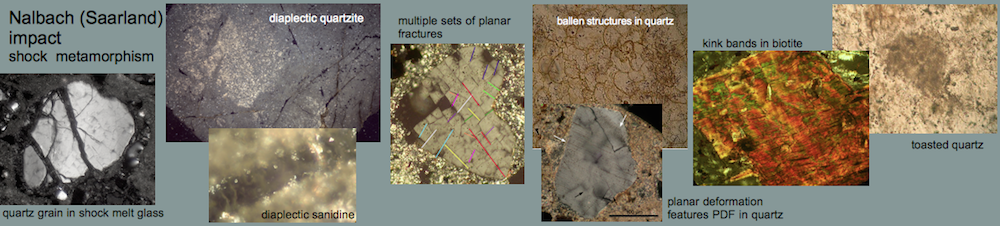
- Ernstson, K., Müller, W., Neumair, A. (2013) The proposed Nalbach (Saarland, Germany) impact site: is it a companion to the Chiemgau (Southeast Bavaria, Germany) impact strewn field? – 76th Annual Meteoritical Society Meeting, Abstract #5058.
- Ernstson, K., Shumilova, T. G., Isaenko, S. I., Neumair, A., Rappenglück, M. A. (2013) From biomass to glassy carbon and carbynes: evidence of possible meteorite impact shock coalification and carbonization. – Modern problems of theoretical, experimental and applied mineralogy (Yushkin Memorial Seminar–2013), Syktyvkar.
- Isaenko, S., Shumilova, T., Ernstson, K., Shevchuk, S., Neumair, A., Rappenglück, M. (2012) Carbynes and DLC in naturally occurring carbon matter from the Alpine Foreland, South-East Germany: Evidence of a probable new impactite. – European Mineralogical Conference 2012.
- Rappenglück, B., Ernstson, K., Liritzis, I., Mayer, W., Neumair, A., Rappenglück, M., Sudhaus, D. (2012) A prehistoric meteorite impact in Southeast Bavaria (Germany): tracing its cultural implications. – 34th International Geological Congress, 5-10 August 2012 – Brisbane, Australien.
- Shumilova, T. G., Isaenko S. I., Makeev B. A., Ernstson K., Neumair A., Rappenglück M. A. (2012) Enigmatic Poorly Structured Carbon Substances from the Alpine Foreland, Southeast Germany: Evidence of a Cosmic Relation. 43nd Lunar and Planetary Science Conference. Abstract.
- Ernstson, K. & Neumair, A. (2011) Geoelectric Complex Resistivity Measurements of Soil Liquefaction Features in Quaternary Sediments of the Alpine Foreland, Germany. American Geophysical Union (AGU) Fall Meeting, San Francisco, Calif., 5-9 Dec. Abstract NS23A-1555.
- Rappenglück, M. A., Ernstson, K. (2008) The Chiemgau crater strewn field (Southeast Bavaria, Germany): Evidence of a Holocene large impact event. – International Conference „100 years since Tunguska phenomenon: Past, present and future“. – June 26–28, 2008, Moscow (Russia).
- Ernstson, K., Rappenglück, M. A. (2008) The Chiemgau crater strewnfield: Evidence of a Holocene large impact event in Southeast Bavaria, Germany. – International Scientific Conference „100 Years of the Tunguska Event“. June 30 – July 6, 2008, Krasnoyarsk (Russia).
- Rappenglück, B., Rappenglück, M. A. (2008) The fall of Phaethon: Is this a geomyth reflecting an impact in Bavaria during the Celtic period? – 33rd International Geological Congress. Session: Myth and Geology. – August 5–14, 2008, Oslo (Norway).